Tuesday, June 01, 2010

Welcome to the Macau-China Bulletin: June 2010

World Prays for the Church in China
Catholics in mainland China prayed on May 24, the day dedicated to prayers for the the Church in the country, although many were unable to visit the popular Sheshan Marian shrine in a Shanghai suburb. The number of pilgrims has not returned to the level before Pope Benedict XVI issued his letter to Chinese Catholics in June 2007 dedicating the feast of Our Lady, Help of Christians as the special prayer day and mentioning the Sheshan shrine in particular, say local sources. This was because the government-sanctioned Chinese Catholic Patriotic Association and Bishops’ Conference of the Catholic Church in China have issued notices since then discouraging cross-province pilgrimages during the Marian month of May, reports UCA News.
Sheshan Marian Basilica at Shanghai
This year’s notice said that as the World Expo is currently taking place in Shanghai, Catholics who wish to go to Shanghai should follow the arrangements set by their provincial Catholic Patriotic Associations and local dioceses, and then get approval from Shanghai diocese. About 3,000 local Catholics gathered at Sheshan on May 24 to celebrate the shrine’s feast day. Auxiliary Bishop Joseph Xing Wenzhi of Shanghai presided over the prayer session and procession, and at Mass at the shrine’s Minor Basilica of St. Mary.
On 23 May, Pope Benedict XVI mentioned the day of prayer at his reflection following the mid-day Regina Caeli, which he prayed with those gathered in St. Peter's Square. "While the faithful in China pray that the unity between them and with the universal Church continues to deepen, Catholics throughout the world -- particularly those of Chinese origin -- unite with them in prayer and in charity, that the Holy Spirit may fill our hearts especially on today’s solemnity," he said.

The Holy Father wrote in 2008 the following prayer for this annual day:
Virgin Most Holy, Mother of the Incarnate Word and our Mother, venerated in the Shrine of Sheshan under the title "Help of Christians", the entire Church in China looks to you with devout affection. We come before you today to implore your protection. Look upon the People of God and, with a mother’s care, guide them along the paths of truth and love, so that they may always be a leaven of harmonious coexistence among all citizens.

When you obediently said "yes" in the house of Nazareth, you allowed God’s eternal Son to take flesh in your virginal womb and thus to begin in history the work of our redemption. You willingly and generously cooperated in that work, allowing the sword of pain to pierce your soul, until the supreme hour of the Cross, when you kept watch on Calvary, standing beside your Son, who died that we might live.

From that moment, you became, in a new way, the Mother of all those who receive your Son Jesus in faith and choose to follow in his footsteps by taking up his Cross. Mother of hope, in the darkness of Holy Saturday you journeyed with unfailing trust towards the dawn of Easter. Grant that your children may discern at all times, even those that are darkest, the signs of God’s loving presence.

Our Lady of Sheshan, sustain all those in China, who, amid their daily trials, continue to believe, to hope, to love. May they never be afraid to speak of Jesus to the world, and of the world to Jesus. In the statue overlooking the Shrine you lift your Son on high, offering him to the world with open arms in a gesture of love. Help Catholics always to be credible witnesses to this love, ever clinging to the rock of Peter on which the Church is built. Mother of China and all Asia, pray for us, now and for ever. Amen!

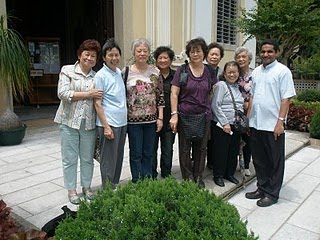
Marking this day on 24 May, together with a few friends and Fr. George Theruvel, CMF who was on a visit to Hong Kong, Frs Ezakias and Jose went on a Rosary pilgrimage, starting from the Cathedral Church to the Rosary Hill Shrine.

China Remembers Matteo Ricci

China together with the Catholic Church has rightly acknowledged the contributions of the great Pioneering Italian Jesuit Missionary to China, Matteo Ricci, whose 400th death anniversary was commemorated on 11 May 2010. Macau Bulletin attempts to look into some of the events of the past months to mark the 400th anniversary:
A Documentary Film on " A Jesuit in the Kingdom of Dragon"

On May 11 2010, the Church commemorated the four hundred years since the death of Matteo Ricci, Jesuit missionary in China, and one of the greatest evangelists of this country, who opened the way for the inculturation of the Christian message and gave impetus to the dialogue between East and West. In the context of these celebrations was made a documentary titled "Matteo Ricci, a Jesuit in the Kingdom of the Dragon" which tells the life of this missionary in the land of the Rising Sun. The 60-minute film was shot in Italy and China and enjoys the patronage of the General Curia of the Jesuits and the Diocese of Macerata, where Matteo Ricci was born.
Gjon Kolndrekaj, as the documentary filmmaker, was the first ever to be allowed free entrance by the Chinese government to film in places like the Forbidden City. Kolndrejak shared what struck him about the figure of Matteo Ricci: "Because he fascinated me as a figure….. First as a man, and then as a man of faith. This awareness and knowledge that he wanted to convey of the greatness that all us people of goodwill can reach."
To commemorate the anniversary of the missionary, Benedict XVI sent a message praising the Jesuit, saying that "his example remains as a model for today of fruitful meeting between the European culture and the Chinese."
Kolndrekaj: "He brought our faith as a witness to a people who knew nothing of this faith, but he also made that race known to Europe. This is an extraordinary thing because it means that he went on to create an intercommunication through to their logical capacities. Therefore I believe that such a character will be remembered in future generations."
Shanghai diocese puts Ricci in focus for year
Shanghai diocese launched its “Year of Matteo Ricci” on May 11, the 400th death anniversary of the pioneering Italian Jesuit missioner to China. The special “year,” which ends on Dec. 11, aims to boost evangelization work among priests, nuns and laypeople, said Bishop Aloysius Jin Luxian of Shanghai at the ceremony.
The event was held in Sheshan Seminary on the outskirts of the city. The Matteo Ricci year is “not only a commemoration, but also has practical significance” for Catholics on how they can continue the priest’s work of adapting the faith to Chinese culture, said the prelate. Auxiliary Bishop Joseph Xing Wenzhi of Shanghai said Father Ricci followed Chinese customs, understood Chinese culture well and treasured his friendship with Chinese intellectuals. He “deserves to be the model for our diocese in spreading the Gospel in these fast-changing times,” he said.
Bishop Aloysius Jin Luxian (center) greeting Massimo Roscigno
Massimo Roscigno, the Italian consul general in Shanghai who attended the event, said people should follow Father Ricci’s example of forging “friendship between China and Italy.” He pointed out that if the priest had not had help from his best Chinese friend Paul Xu Guangqi, he could not have completed his writings in Chinese or translated Chinese classics into Latin. Bishop Xing told UCA News that the diocese would ask all priests to promote Father Ricci’s spiritual values.
Activities during the seven-month program include a seminar, a hymn and prayer gathering, and a priestly ordination to close the special “year.” The May 11 ceremony was held after the conclusion of the diocesan pilgrimage held at Shanghai’s Sheshan Marian Shrine the same day. About 1,000 Catholics gathered at the hilltop Minor Basilica of St. Mary to pray for strength to follow in the footsteps of Father Ricci.After the Mass, they were given leaflets promoting the sainthood causes of Father Ricci and Xu.
Xu-Ricci institute launched in Shanghai
The Fudan University in Shanghai launched its Xu-Ricci Dialogue Institute on May 11, the 400th death anniversary of the pioneering Italian Jesuit missioner to China, Father Matteo Ricci.The institute, which comes under the university’s School of Philosophy, hosted a colloquium that day to commemorate the priest’s contribution to East-West dialogue.
Participants at the Fudan University forum in Shanghai
The new center is named after Father Ricci and his closest Chinese friend, Paul Xu Guangqi, the first Catholic in Shanghai. According to French Jesuit Father Benoit Vermander, co-director of the institute, it is the first Chinese academic center to bear these two names. The institute aims to promote academic research, the teaching of religious studies, and comparisons between Chinese and Western cultures and philosophies. About 70 Chinese and foreign scholars in the fields of economics, philosophy and religious studies attended the May 11 colloquium, which saw participants discussing religious dialogue and the challenges faced by the Chinese and global communities.
Ricci digital dictionary launched
Many of them also attended the launch of the digital edition of the Grand Ricci, a Chinese-French dictionary, at the Shanghai Museum later in the evening. The dictionary, billed as the largest Chinese-foreign language dictionary in the world, is published by the Taipei Ricci Institute. Father Ricci came to mainland China in 1583 and spent 27 years here until he died in Beijing on May 11, 1610.
The world map drawn by Fr. Ricci
The Jesuit, known as Li Madou among the Chinese, is widely regarded as the founder of modern-day Christianity in China and a pioneer of East-West cultural exchange. He and Xu, a Catholic scholar and imperial official, collaborated closely to translate Western texts into Chinese, and Confucian classics into Latin. Although Father Ricci did not leave his mark in Shanghai, his Jesuit confrere Father Lazzaro Cattaneo introduced Catholicism here in 1608 at the request of Xu. Shanghai gradually became a major center for the Jesuits’ missionary activities in eastern China, particularly after foreign powers forced China to open its doors in the mid-19th century.On 16 of May, Fr. Rossa together with his brother and his family were in the cathedral of Beijing, the place where the Fr. Matteo Ricci was working 400 years ago. In the photo are: Fr. Rossa, CMF, brother of Fr. Rossa, Victor, Bety his wife and their daughter Andrea.

Hopes for Ricci’s helper to become a saint too
Catholics are hoping that Paul Xu Guangqi, the first Catholic in Shanghai, may also be proclaimed a saint along with Father Matteo Ricci. Italian Jesuit Father Matteo Ricci (1552-1610) and Catholic Chinese imperial official Paul Xu Guangqi (1562-1633) collaborated closely in Beijing to translate Western texts on mathematics, hydraulics, astronomy, trigonometry and geography into Chinese.
They also translated Confucian classics into Latin so as to introduce the dominant Chinese philosophy to Europe. Father Ricci arrived in Beijing in 1601 and the Chinese emperor allowed him to stay in the capital until his death on May 11, 1610. His native Macerata diocese in Italy re-launched the process of his beatification in January.
Some Shanghai Catholics told UCA News that they hoped Xu could also enjoy the same honor, as their diocese would begin a similar process soon. Xu, a Shanghai-born bureaucrat, agricultural scientist, astronomer and mathematician of the Ming dynasty, first met Father Ricci in 1600 and was impressed by his knowledge and holiness.Xu was baptized three years later and took on the name of Paul. He then invited another Jesuit priest to spread the Gospel in his birthplace. His family became the first Catholic family in Shanghai.
Xu died in Beijing in 1633 and was buried in today’s Xujiahui district in downtown Shanghai, where his family used to live. In 1847, Jesuit missioners built their missionary headquarters on a large piece of land in Xujiahui.
Ricci exhibition in Shanghai
Father Ricci and Xu translated Euclid’s Elements, the mathematical and geometric treatise by the Greek mathematician, and their work is on display at the Shanghai Museum from April 3-May 23. Shanghai is the second stop of the touring exhibition titled Matteo Ricci: An Encounter of Civilizations in Ming China, which would coincide with the Shanghai World Expo, which runs from May to October.

The exhibition has attracted crowds of visitors, including local priests, nuns and laypeople. They described it as “worth seeing” and “very fruitful.” The exhibition is organized by Italy’s Marche Region, which covers Macerata, to mark the death anniversary of Father Ricci and the 40th anniversary of diplomatic ties between China and Italy. The 113 exhibits come from museums in mainland China and Italy. In the Photo: Justin, brother of Fr. Rossa and his family at the Museum of History in Shanghai where the exhibition on Matteo Ricci is arranged

A day in the life of Fr. Jojo - Claretian Missionary in Macau

Fr. Jojo Ancheril shares his experiences, views and vision of a missionary in Macau.
What is a typical day of a Claretian Missionary in Macau like? Can you describe some of your activities?
Three years ago I arrived at Macau after working five years in very poor missions in the North East of India. After studying the language Cantonese the Bishop of Macau assigned to me to work in the Parish of San Lorenzo. My day in the morning begins uniting me to the prayers of people; and the celebration of the Eucharist. Frequently I also celebrate the Mass in old age homes and others centers of Caritas.
How is the parish where you are serving? Give us some details…
The parish of San Lorenzo is the most beautiful church of Macau and is visited by many tourists every day. And it is a very active parish. The P. Domingo, the parish priest, is the youngest priest of the diocese and works by far enthusiasm and creativity. There are many pious associations in the parish and I am associated with some of them. Some days I go to different schools to hear the confessions and to be with the young people and to speak to them, to accompany and to help them in whatever way I can. I keep myself occupied meeting people, especially old that looks for our aid, visiting patients, visiting the jails and visiting the handicapped people where groups of nuns work with admirable dedication.
You speak the language of the people already. Is it still difficult to communicate with them? What are the challenges?
Well I do understand the language of the people but sometimes it is difficult to communicate with them. The Cantonese language has got many double meanings and being a foreigner it is difficult to understand the nuances of the language often. The culture and custom of the people are very different from mine and it is really a challenge to get into a new culture and custom.
You are organizing the youth… what are the activities you have with them?
The important thing is to be with them. We have different activities, meetings, games, prayer services etc. Many of these youngsters are very generous and are ready to confront challenges than to escape into the comforts of an easy life that the Urbanised Macau offers to them
What can a foreign missionary do in Macau?
As missionary we have total freedom of movement and action in Macau. Although this is China we have religious freedom, not like in the Mainland. Macau is ruled by "one country, two systems" theory. It is necessary to gain the affection and the support of people. This is an uphill task but one can indeed scale.
What are the source of your joy and fulfillment as a missionary?
Well there are very many opportunities to live and practice our missionary life here in Macau and it gives an inner joy and peace. The most joyful and satisfactory moments of my priestly life are the moments in which I administer the sacraments, especially the sacrament of Reconciliation.
What are the greatest challenges in your ministry?
The materialism, the language, the new culture and customs… Macau is the city of "game". It attracts Thirty million tourists into this city of half a million inhabitants. For the Christians of Macau, to cultivate and to mature in faith and Christian commitment are a great challenge, especially for the young people.

Tuesday, May 04, 2010

Welcome to Macau-China Bulletin, May 2010

Parish Day Celebrations in Hong Kong
Over 400 faithful participated in a Concelebrated liturgy by 14 priests presided by Rev. Michael Yeung, VG, Diocese of Hong Kong, on 1 May 2010, to mark the Parish Day Celebrations of Christ the Worker Parish, Ngau Tau Kok. The Parish, under the pastoral care of Fr. Tom Peyton MM and Tony Brennan MM, the Maryknoll Fathers, is the one of the vibrant parish communities in the Diocese of Hong Kong.
Rev. Fr. Michael Yeung, the Vicar General and Head of Caritas, expressed his happiness to be part of the celebrations as Christ the Worker Parish is the only parish in the diocese which functions totally in the facilities of Caritas. During the Eucharistic Celebration, the VG administered the Sacrament of Confirmation on 14 faithful.
The Macau Community of the Claretians are associated with the Parish ever since Fr. Jojo began to stay in the parish in pursuit of his Chinese Language studies. Now, Frs. Ezakias Antony Swamy and Jose Cherukara stay in the parish while attending their classes in the Chinese University. Frs. Rossa and Jojo from Macau also were part of the Parish Day celebrations, which concluded with Agape Meal at 12.30 pm.

Macau-Hong Kong Claretians meet in HK

Frs. Jose, Rossa, Jojo and Ezakias at Christ the Worker Parish, Ngau Tau Kok
The Macau - Hong Kong Claretian Community came together at Ngau Tau Kok, Hong Kong on 12 April, to evaluate the varied projects undertaken by the Community and deliberating on its future course of Action, in view of the upcoming General Assembly in July. The Community sets highest priority in learning the language during these initial years of the Claretian presence in the region. Ongoing formation of missionaries, formation of lay leaders and to provide them with sufficient study material through publication of adequate Biblical and Catechetical material shall be the focal point of our Ministry in the Region in the coming years.

Fr. Rossa Celebrates 65th Birthday

Fr. Alberto Rossa turned 65 on 29 April. The Community had a beautiful celebration in Hong Kong together with our friends and Associates from Hong Kong on 1 May 2010. We gratefully acknowledge the wonderful ministry Fr. Rossa is involved in for the Cause of the Gospel in China and we pray for the Heaven’s Choicest Blessings upon him in the years to come. A few stills from the evening!:

Monday, May 03, 2010

Ricci symposium brings together East and West

More than 90 scholars presented papers at Fu Jen Catholic University in a four-day symposium to commemorate the 400th anniversary of the death of Jesuit Father Matteo Ricci. More than 300 participants from around the world, including 25 from mainland China, gathered on April 19 to discuss East-West dialogue in terms of philosophy, history, religion, culture, science and education.
Father Ricci, an Italian missioner commonly known as Li Madou to Chinese people, was praised for his promotion of dialogue between the East and the West. The organizers had invited some mainland Church people who are involved in cultural research wiht the objective of enhancing and deepening cultural exchanges between mainland China and Taiwan.

Larry Wang Yu-yuan, Taiwan’s ambassador to the Holy See, told UCA News it was good to see the mainland participants coming. There should be more cross-straits exchanges in the academic and religious circles, especially for the Catholic Church, and not just exchanges focusing on the economy, he said. Wang was among the guests who made opening addresses for the event.

Guests unveiling the bronze statue of
Father Matteo Ricci

Cardinal Shan said in his speech that 400 years ago, Father Ricci had achieved the principles of interreligious dialogue as proposed in the Second Vatican Council, namely “mutual respect, mutual understanding and cordial cooperation.” “The secret to Ricci’s success” was respecting Chinese culture without blindly following it and humbly introducing Western science and technology to China. This went against the culture of empty talk among the Chinese scholars of his time, the cardinal said.

The international symposium also premiered a documentary film, Matteo Ricci, a Jesuit in the Kingdom of the Dragon, directed by Gjon Kolndrekaj. Dignitaries unveiled a bronze statue of Father Ricci in front of the Ricci Building of Fu Jen.
Asia News reports the follwoing from Rome:The scientific, cultural, religious dialogue, that was started 400 years ago by Matteo Ricci is still very present in China today marked by a huge economic development, but one which also creates abysmal poverty, conflict and a spiritual vacuum that can only be bridged by a proposal that can combine science and spirit, economy and religious freedom. The Chinese leadership’s own program to build a "harmonious society, a harmonious world" also risks failure. These were the conclusions reached at the international conference on "The China of Today and Matteo Ricci," held 29 April in the sumptuous "Pietro da Cortona" hall at the Capitoline Museums in Rome [To read the full story click here: http://www.asianews.it/news-en/China-in-the-wake-of-Matteo-Ricci;-even-the-economy-needs-religious-freedom-18286.html]

Church groups rush aid to China’s quake victims

Church organizations in mainland China are mobilizing resources to assist quake victims in Qinghai province, northwestern China. On April 14 morning, Yushu county in the southern Qinghai was hit by a 7.1-magnitude earthquake which killed more than 1000 people and injured another 10,000.
The Relief Department of Jinde Charities in Hebei province has contacted its local Church partner on the situation. Father Joseph Li Dongsheng of Qinghai told the nationwide Catholic NGO that quake survivors are presently staying in the open-air area at a racecourse for fear of aftershocks. The road leading to Yushu has been cut off and most of the houses have collapsed. The priest said there is only one Catholic family living in Yushu, where 93 percent of the population is ethnic Tibetan. The three members of the family, which provided the information on the situation, are unharmed although their house is slightly damaged. According to China’s official Xinhua News Agency, more than 100,000 victims spent the night braving a temperature of minus 4 degrees Celsius. Overseas Church partners, such as Caritas International and other Caritas network members, have called or emailed Jinde to express their desire to cooperate with Chinese Catholics in carrying out relief work. Meanwhile, the Catholic Social Service Center of Xi’an diocese , based in the capital of Shaanxi province, has appealed for donations and prayers for victims. The center “feels that it is our responsibility to contribute as much as we can to help the victims in Yushu,” says the appeal.

In Rome, Pope Benedict XVI prayed for quake victims at the end of his general audience in St. Peter’s Square on April 14. “I am praying for the victims and am spiritually near all those affected by this very serious tragedy. I implore God that they may find relief from their suffering and courage in this time of adversity. I hope that there will be no lack of solidarity shown,” he said. In 2008, a stronger 8.0-magnitude quake had struck neighboring Sichuan province.
Our friend Fr. Michael Saso, adds from Los Angeles, US:
The school/orphanage we (Sino-Asian Institute) built in Yushu/Jiegundo, the earthquake area, was damaged, but none of the students were injured! We thank God for this, indeed a great blessing; only the Catholic relief agency form HK, Caritas, is being allowed in, all of the Buddhist monks whom I know, who helped build the school, have been turned away. I hope to go there, or at least send help.

Censors allow Xinjiang bishop back to blogging

An elderly bishop in Xinjiang Uighur Autonomous Region has launched his second blog as a way of reaching out to his flock in northwestern China. Bishop Paul Xie Tingzhe of Urumqi is no stranger to cyperspace. The 79-year-old used to join a Chinese Catholic chatroom and even sang Latin hymns online in 2005.
In 2007, he started a blog to upload his homilies. A year later, however, he found he was unable to login to it. On April 3, Holy Saturday, this year, he decided to start another blog, XPaul1600 to upload his homily for Easter Sunday.The bishop has since posted motivational stories and biblical articles. The Internet service in Xinjiang had been restricted since ethnic clashes occurred in Urumqi, on July 5, 2009, to prevent radicals mobilizing people online. Internet restrictions have loosened gradually since March 20 this year, according to mainland media reports.

He surmises that he could be a target of surveillance. The local government only recognizes the Vatican-approved bishop, who was clandestinely ordained in 1991, as a priest. A chatroom operator who knows Bishop Xie told UCA News that the prelate’s willingness to use the Internet at his age shows that he is an open-minded person. He is “the only bishop that I know who is interested in using chatrooms,” she said. Bishop Xie says he supports the idea of lifelong learning. He has even helped his priests to enter the digital world. - Courtesy: UCAN

First mainland bishop ordained in two years

The diocese of Hohhot in northern China welcomed a new bishop on April 18 after five years without one. Bishop Paul Meng Qinglu, 47, was ordained the seventh bishop of Hohhot, based in the capital of the Inner Mongolia Autonomous Region. He was the first bishop ordained in mainland China since December 2007.
Concelebrating prelates included Bishops John Liu Shigong of Jining and Matthias Du Jiang of Bameng, both from Inner Mongolia, and Bishop Joseph Li Jing of Ningxia. Some 80 priests from Hohhot and four other dioceses in Inner Mongolia, who were mostly his classmates and students from the seminary, also concelebrated the Mass. Local Catholics said all the 500 tickets for seats in the church and 2,000 tickets for places in the courtyard were taken up.
Bishop Paul Meng Qinglu (kneeling)
during his episcopal ordination

Many laypeople could not enter the church compound to attend the ordination Mass. Bishop Meng told UCA News April 19 that since the diocese has had no bishop for five years, the priests have become used to managing their parishes in their own way. “I will strive to bring diocesan management back on the right track so that pastoral and evangelistic work will be gradually enhanced,” he said.
The bishop received a papal mandate and the approval of the Bishops’ Conference of the Catholic Church in China (BCCCC) for his ordination. He was elected as bishop candidate in June 2005, a month after his predecessor Bishop John Baptist Wang Xixian died, aged 79. Bishop Meng recalled that he had endured pressure and difficulties during the five years he has been preparing for his episcopal ministry.His application to the BCCCC had been put on hold during the Beijing Olympic Games in 2008 and the celebrations of the 60th anniversary of the People’s Republic of China last year, he said. Hohhot diocese currently has 21 priests serving 65,000 Catholics. The regional seminary has suspended operation four years ago for want of students but did not officially close down. Seminarians are sent to study in different seminaries across China, Bishop Meng said. Catholicism was introduced to Inner Mongolia in the 18th century. The extensive region, including Hohhot, had been served by missioners of the Congregation of the Immaculate Heart of Mary until the 1950s. - Courtesy: UCAN